{ OpenDDE Introduction /}
OpenDDE is an open-weight, all-atom model that co-folds proteins, nucleic acids, and small molecules, scaling from structure prediction to design and optimization.
{ Capabilities /}


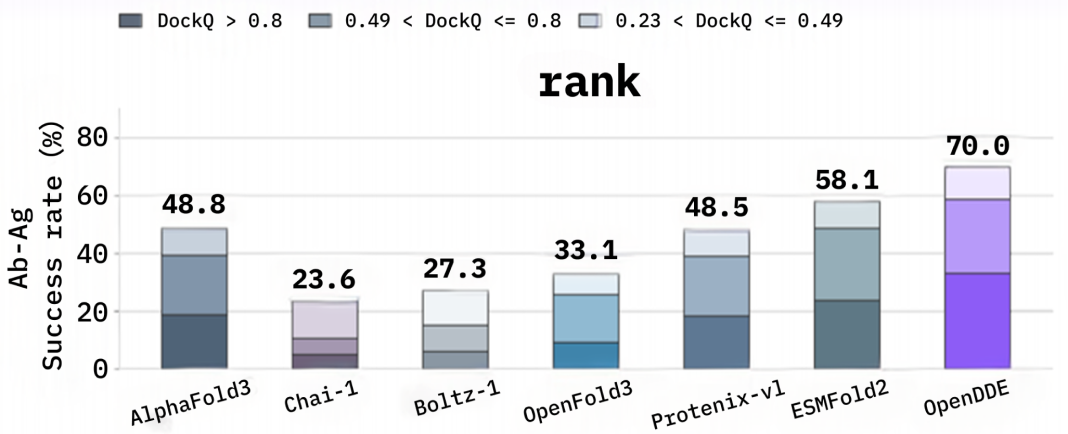
AlphaFold3 values are as reported in Abramson et al., Nature (2024). Chai-1, Boltz-1, OpenFold3, Protenix-v1, ESMFold2, and OpenDDE were run by Aureka under matched conditions. Success is defined by DockQ thresholds, as shown.
Best Ab-Ag success rate on FoldBench-AB (RANK) — ahead of every model tested.
Ranked first across PXMeter-AB, FoldBench-AB and 2026ARK-AB, under RANK and ORACLE.
Open weights, code and a prebuilt Docker image — build on all of it, end to end.
Modern drug discovery rarely asks about a single molecule in isolation. It asks how a candidate binds, how a complex assembles, and how to reshape that interaction toward a therapeutic goal. OpenDDE is built for exactly this: an all-atom biomolecular foundation model that co-folds every component of a system together, rather than predicting structures one chain at a time.
OpenDDE was built as one model for folding, reasoning about, and generating biomolecular structures. Design is part of the architecture, not a feature added to a structure predictor.
{ OpenDDE Introduction /}
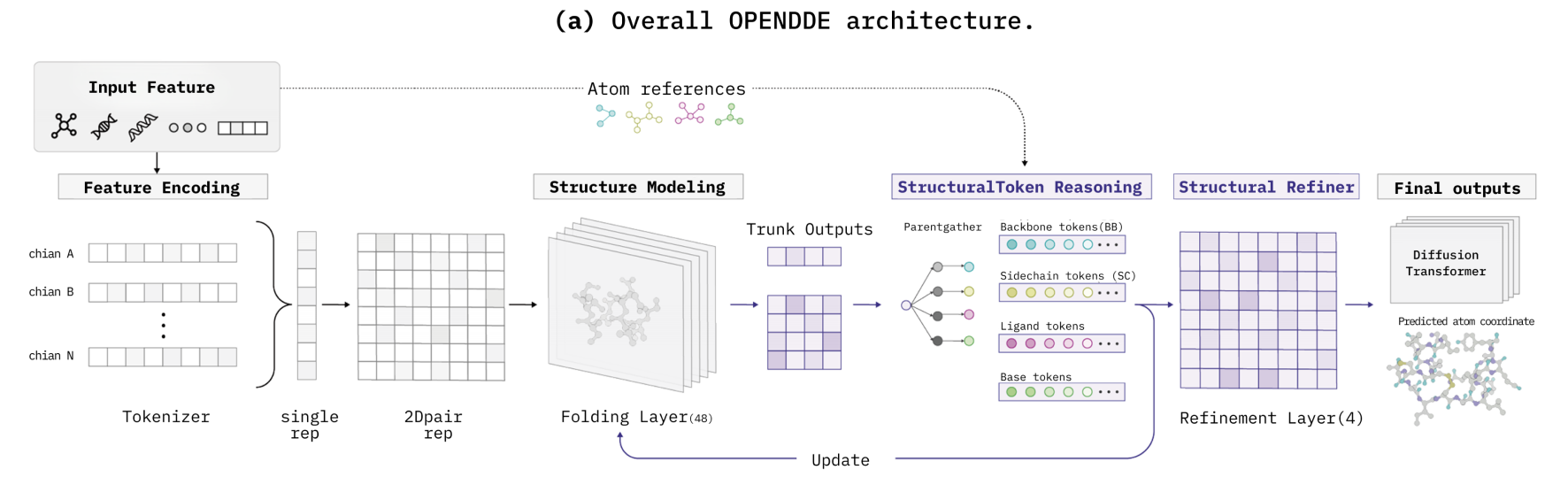
OpenDDE is not a structure predictor with a design mode bolted on. Three choices — how it reasons, how it is supervised, and how it is framed — let a single model fold, reason about, and generate biomolecular structure.

Model architecture
The model first builds a representation at the residue level. It then expands this into chemically explicit structural tokens and refines them in latent space before generating any coordinates. The result is a structure that is correct at the atomic level, not just in overall shape.
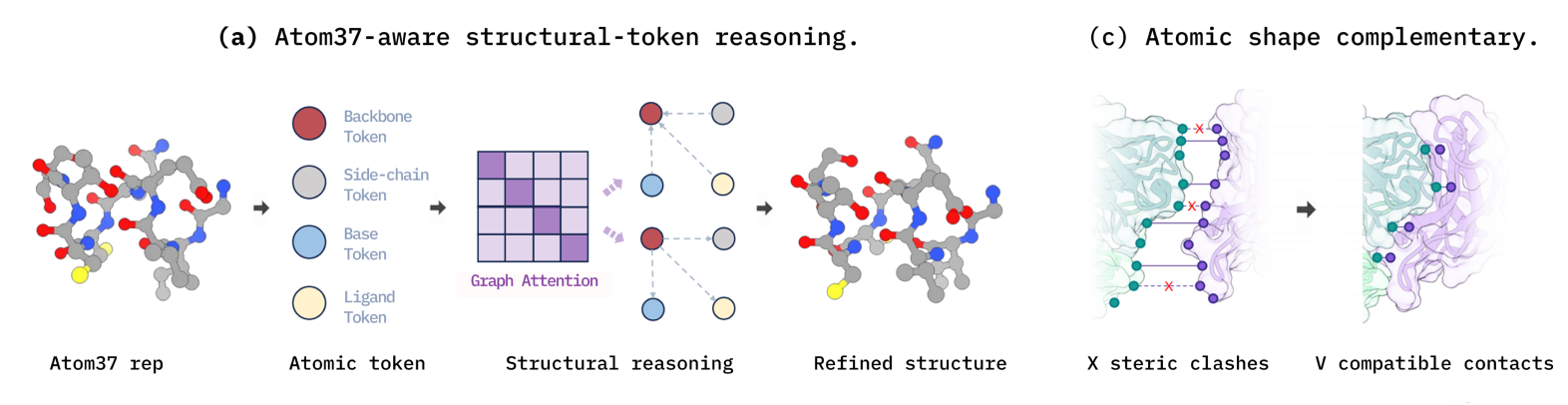
Atomic tokens refine structure before coordinate generation.
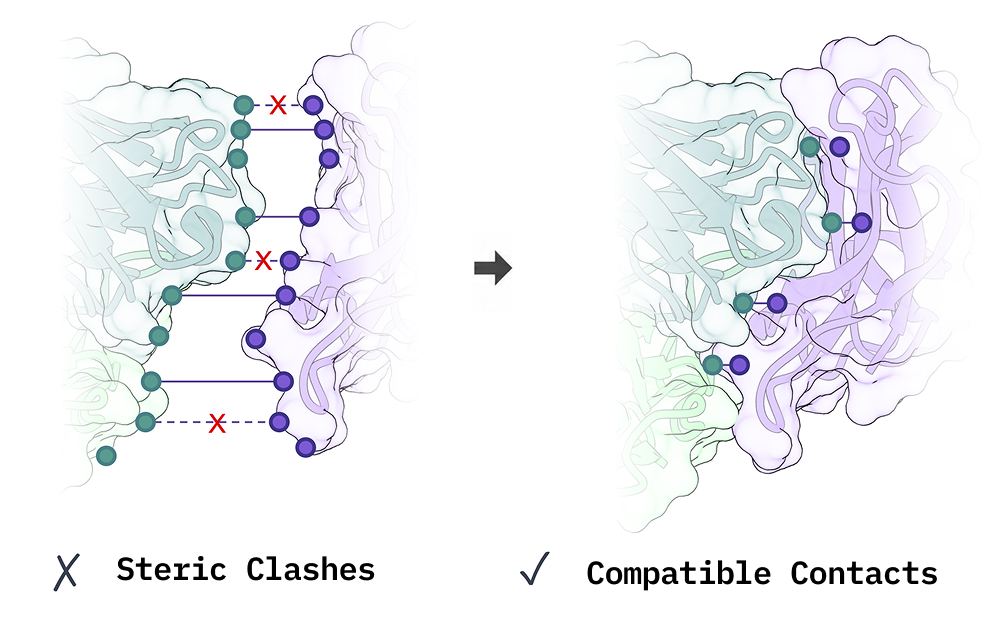
Clashes versus compatible contacts.
During training, predicted interfaces are scored against native ones on three measures: surface orientation, spacing between chains, and contact quality without clashes. This teaches the model to produce interfaces that fit together the way real binding partners do.
OpenDDE treats structure prediction and de novo design as the same conditional denoising problem. With no atoms fixed, the model predicts a structure from scratch. With a target fixed, such as a binding pocket or an antigen, it designs a molecule to fit that target.
Fold the whole assembly from scratch.
Hold a pocket or antigen fixed; generate the rest.
Coarse-to-fine
Lock-and-key geometry
Conditional denoising
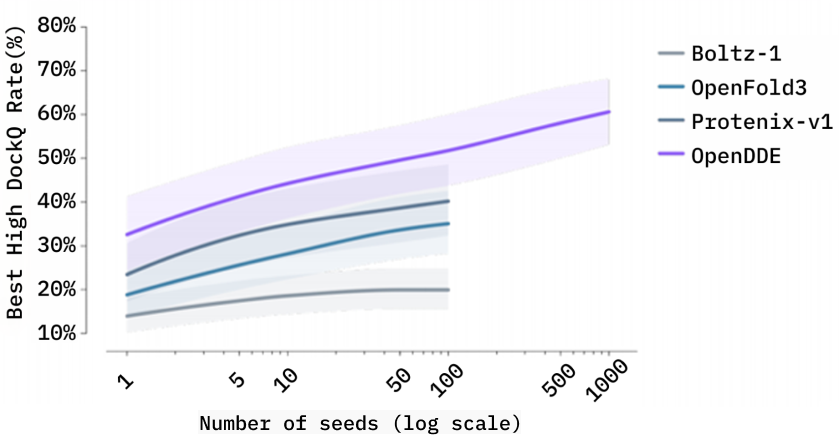
OpenDDE has the highest success rate of every model we tested on three antibody–antigen benchmarks: PXMeter-AB, FoldBench-AB, and 2026ARK-AB. It leads whether we score the top-ranked prediction (RANK) or the best of all samples (ORACLE), and at every DockQ quality tier.
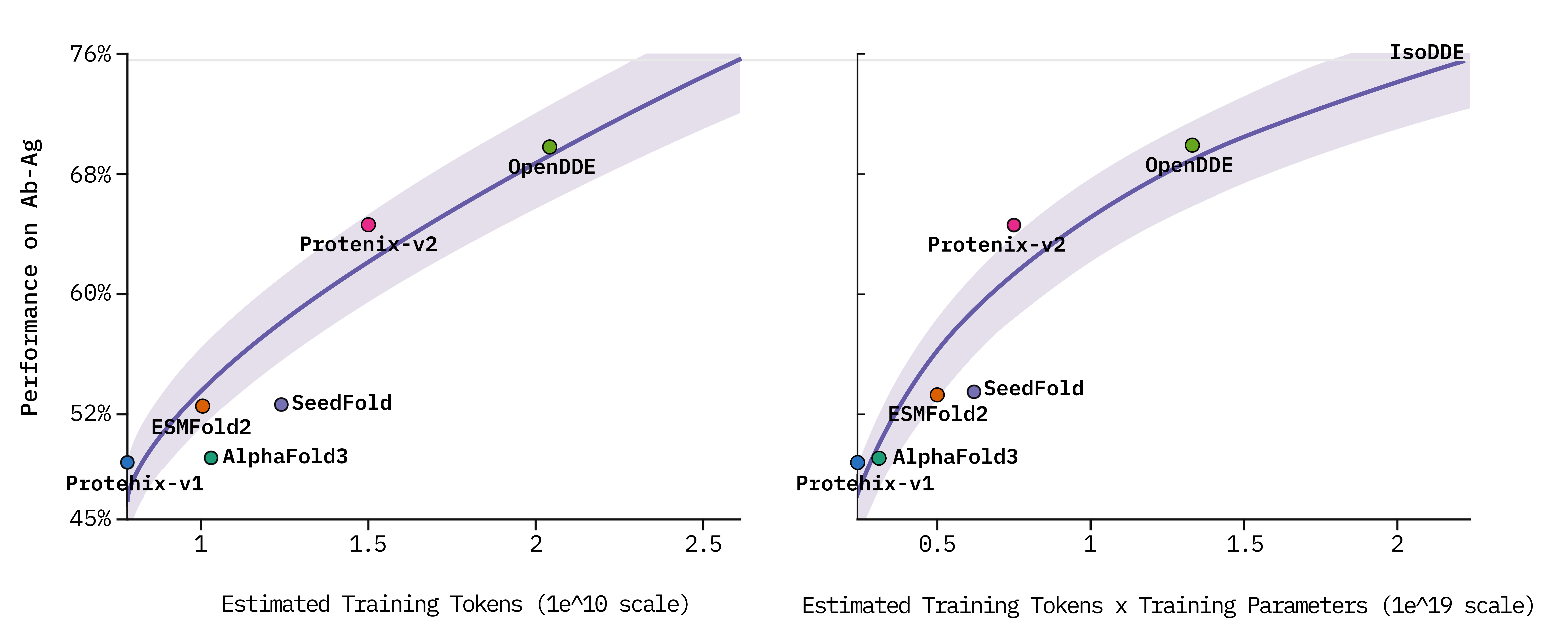
Relative to its training compute, OpenDDE delivers more antibody–antigen accuracy than prior folding models. It gets more out of each token and each parameter, which places it on the efficiency frontier. We expect performance to keep improving as we scale training further.

Scaling frontier across training compute.
{ Build with US /}
We welcome people who want to build open, AI-native drug-discovery systems that connect molecular reasoning with real-world medicines.
We collaborate with biotech companies, pharmaceutical partners, academic labs, and technology teams working at the frontier of AI, biology, and therapeutic discovery.